
Another fine post from Catalyst, which (and whom) I wish would be the catalyst for changing the hearts and minds of the rich and super-rich elites of this country. Thank you again, Catalyst.

(Image credit: State Library of Victoria H96.160/2603)
Bicycling along a tightrope was how Harold Macmillan( Britain’s Prime Minister 1957-1963) explained how demanding formulating economic policy was and is. After the war and the subsequent years of bleak austerity, Macmillan famously reminded Britons that You’ve never had it so good.
In Australia too, Prime Minister Robert Menzies (1949-1966) was in the fortunate position of presiding over a high growth period. And it was prosperity that reached almost all Australians.
As Andrew Leigh writes in Battlers and Billionaires: The Story of Inequality in Australia:
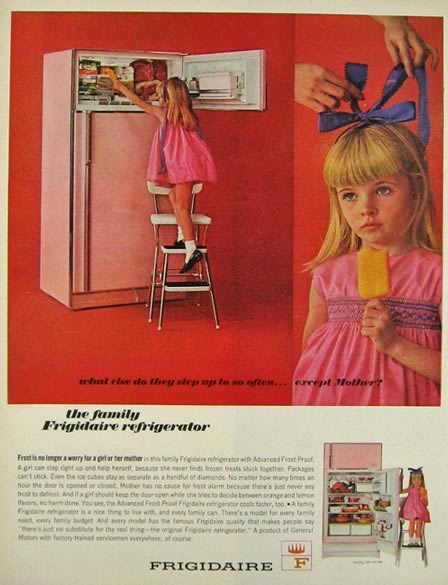
There was a fridge in 97 percent of Australian homes in the 1960s, an appliance that most Britons, Germans and Italians did not yet possess.
(Image credit: Attic Paper)
He adds that Australians also took for granted owning a washing machine, a vacuum cleaner, a radio, and a television.
When we arrived as migrants in the early 1970s I was overawed by the variety of small electrical appliances for sale and which were present in so many ordinary homes.

(Image credits: Hoover washing machine; Electrolux vacuum cleaner; radiogram; PYE TV receiver)
Working conditions in Australia were better, the pay was better, the flat we rented was superior to the one we had left. What’s more, people were friendly, quick to help and the weather was so good. If it wasn’t quite a land of milk and honey, it was certainly a very favourable place to be.
Dreams that had seemed impossible were realised here: a home of our own with a swimming pool. Four weeks paid holidays (introduced 1974), penalty rates, and a more relaxed lifestyle.
Life was good, and it began to change so slowly that at first it was hardly noticeable. Management in the 1980s suddenly became the preserve of the young, and American ideas flourished. Pie charts and motivational talks were the order of the day. Personnel departments – alarmingly – were now presumed to manage ‘human resources’ .As the terminology changed, people became just another disposable asset
No longer could people expect lifetime careers. The rich list flourished and flamboyant millionaires indulged their sporting and others passions, while they sold off their companies. Alan Bond, Christopher Skase, Rene Rivkin, and Laurie Connell bought and sold companies and spent money lavishly: polo ponies, racing yachts, Van Gogh paintings and extravagant parties. Businessmen suddenly became the corporate elite and excess became commonplace. Think of the gloss and glamour of the TV shows Dynasty and Dallas.

(Image credits: Alan Bond; Christopher Skase; Rene Rivkin; Laurie Connell)

(Image credits: Dynasty; Dallas)
As the 80s came to an end some of the tycoons were jailed, some exiled themselves, some died, and some just faded from the limelight. The gulf between them and us had widened, Australia had become less interested in being egalitarian.
Interest rates climbed: rising from 12% they spiralled to 18%. In the early 1990s we had “the recession we had to have”. The boom mentality had led to a spending cycle which could not last. Dreams collapsed, firms failed, and jobs were lost. Many people were retrenched, in some cases (like mine) more than once. Houses went up for sale, as people could no longer afford their Australian dream. Firms merged or closed, leaving staff afraid for their superannuation. People found their job “rationalised” or downsized and the job for life disappeared, to be replaced by increased part-time and casual work.

(Image credit: The Age)
Insecurity was in the air, and like a game of snakes and ladders the assets that had climbed so high tumbled in value. If the 80s had been one long high, the 90s were a much more sober affair. But for some the party never stopped – while those on the lower rungs of the ladder were reeling, those at the top just kept on making money.
In 1992 Lang Hancock died worth about $150 million – a sizable fortune. These days, though, his daughter Gina Rinehart’s “worth” is estimated as $29 billion. In Battlers and Billionaires, Andrew Leigh asks:
Is she really 190 times more ingenious than her father?
He concludes that the income boost is due mostly to a tenfold increase in the price of iron ore.
At the same time he estimates that half of Australian families have an annual pre-tax household income of $77,220 or less. Many people take home considerably less. Life at the lower income levels needs clever budgeting and an unenvious spirit. Ingenuity, not cash, is the order of the day: bulk buying, home cooking, op shopping and the ability to amuse yourself and seek out free events can make life better, even at this income level.
As someone commented to me,
I can always tell middle class kids – even in op shop clothes – they’ve got straight, white middle class teeth.
They may find it fun pretending to be poor. Many don’t realise that not everyone enjoys private schooling, with Foxtel and broadband on tap, an iPad, a job lined up by daddy or mummy, access to the latest books and films and their own car, not to mention annual holidays, often overseas. These kids have known nothing else, but older people have less excuse for ignoring the growing inequality in our society.

(Image Credit: Dental Implants Review)
Why should a TV personality – an ‘ordinary mum’ type – reportedly be paid $700,000 a year? How much should her opinions be allowed to influence the rest of us? How can these people speak for and represent the majority?
And if she is out of touch, what about those at the very top, the rich and super rich? Their share of economic prosperity has tripled in the period 1984-2012 from 0.8% to 2.8%, according to Andrew Leigh. At their income levels these percentages really add up. So does their lack of understanding of those who will never make the rich list, who are not members of what some have dubbed the lucky sperm club.

(Image credit: The Age)
PLEASE NOTE: This was the Australian Rich List for 2011
That’s why we need a Labor government: to encourage people, not exclude them. To keep the fair go alive, to represent the majority of people, the ones that the elites like to forget about, so that we don’t end up with a more divided society, the enclaves of privilege contrasted to the rest of us.
If we have been fortunate, whether by inheritance or education, by intelligence or health, don’t we have an obligation to the rest of society? Shouldn’t we use our gifts to help others? Or will we allow the user pays mentality to take hold and grow, forgetting that not everyone has the capacity to pay?
© Catalyst 2013




 THE PUB